
What if your lunch today is quietly stealing hundreds of thousands of dollars from your future?
That may sound dramatic.
But when you understand how money really works — especially compound interest — you start to see everyday spending in a completely different light.
This isn’t about never enjoying life. It’s about understanding the true cost of your habits. Because it’s not just the $5, the $100, or the $1,200 you spend.
It’s what that money could have become.
Let’s talk about how people really end up broke — not from one big mistake, but from a thousand small ones.
You Can Literally Eat Your Future Alive
Most people think financial ruin comes from bad investments or catastrophic events.
But in reality?
It often comes from routine spending disguised as normal living.
If merchants and credit companies can’t get your money through status purchases — flashy cars, luxury brands, impulse buys — they’ll get it another way:
Through your stomach.
Let’s break this down.
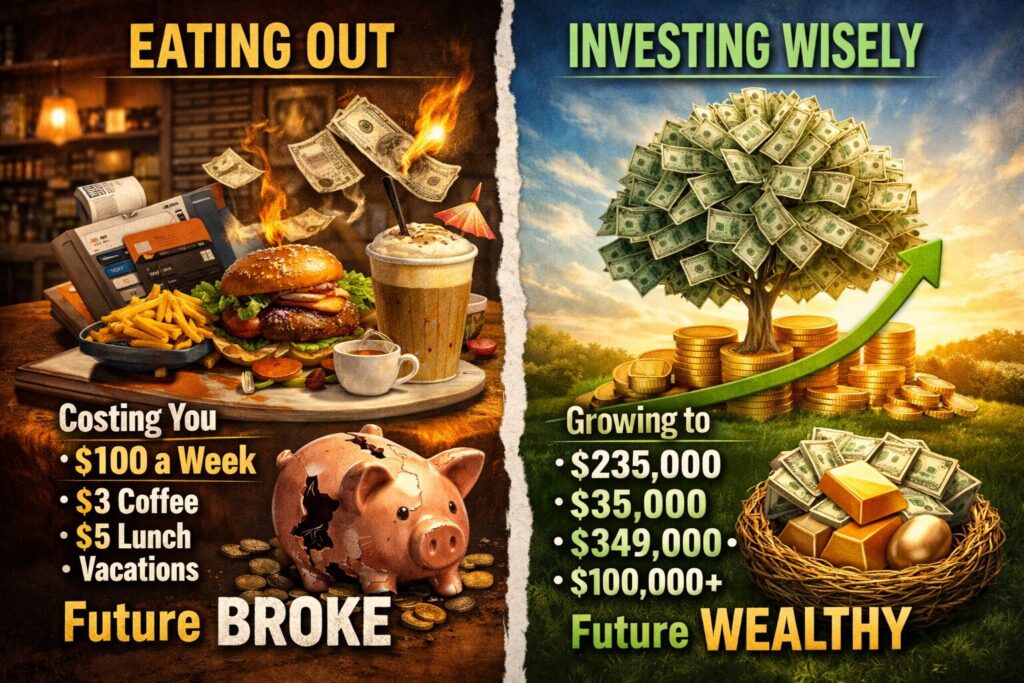
$100 a Week on Dining Out
That doesn’t sound outrageous. Many families spend more than that.
But if you invested that $100 per week for 20 years at an average 8% return?
You wouldn’t just have the money you saved.
You’d have approximately $235,000+.
That’s nearly a quarter million dollars — spent on dinners.
And remember:
It’s not the $100 you’re losing.
It’s the $235,000 it could have become.
The $3 Cappuccino That Costs $35,000
Let’s go smaller.
$3 per day on a cappuccino.
Over 20 years, invested at 8%, that daily habit could grow to over $35,000.
Now ask yourself:
Was that coffee really worth $35,000 of retirement freedom?
Again, this isn’t about deprivation. It’s about awareness.
Small habits compound — either for you or against you.
The $5 Lunch That Costs $349,000
Here’s where it gets even more powerful.
If you spend $5 a day on lunch instead of bringing food from home, over a 40-year career, invested at 8%, that $5 per day could grow to approximately:
$349,000
Read that again.
Five dollars.
Three hundred forty-nine thousand dollars.
That’s the power of long-term compounding.
Now imagine if you put that lunch on a credit card.
The food lasts a few hours.
The payment can last years.
Vacations: The Six-Figure Getaway
Let’s talk about something most people never calculate.
If you spend $1,200 per year on vacations over 20 years instead of investing it at 8%, you’re potentially sacrificing over:
$100,000 in retirement wealth.
Again — it’s not the $1,200.
It’s what $1,200 could grow into.
When you start seeing spending through this lens, everything changes.
Where Does Your Money Actually Go?
This session forces one uncomfortable question:
Where does your money go?
Most people don’t know.
They assume:
- “I don’t make enough.”
- “Everything is expensive.”
- “I deserve this.”
But the truth is often simpler:
Money leaks through lifestyle habits.
And then something worse happens.
Those lifestyle purchases are often made using credit.
The Household Debt Explosion
According to research from the director of economic research at Northern Trust Corporation, household debt changed dramatically after the mid-1980s.
From 1965 to 1985, household liabilities stayed relatively consistent compared to disposable income.
But after 1985?
Debt began rising faster than income.
By 1999, household liabilities exceeded 100% of disposable income.
That means people were spending more than they earned.
And there’s only one way to do that:
Credit.
Renting Today’s Lifestyle With Tomorrow’s Income
When you use credit to finance lifestyle spending, here’s what you’re really doing:
You’re renting today’s comfort with tomorrow’s money.
But when tomorrow comes?
You still owe yesterday.
So what happens?
You use more credit.
Now your monthly payments grow.
Now your flexibility shrinks.
Now your future gets tighter.
This cycle is mathematically doomed because:
Credit is compound interest working against you.
When you invest, compound interest builds wealth.
When you borrow, compound interest builds debt.
The math doesn’t care about your intentions.
It only responds to direction.
The Real Cost Isn’t What You Spend — It’s What You Lose
The central idea you must understand is this:
It’s not just the money you spend.
It’s the money that money could have become.
That’s the silent wealth killer.
Every dollar has two possible futures:
- It compounds for you.
- It compounds against you.
There is no neutral.
So How Do They End Up Broke?
They don’t crash.
They drift.
- $5 lunches.
- $3 coffees.
- $100 dinners.
- $1,200 vacations.
- All placed on credit.
- All justified as “normal.”
Multiply that over decades.
Add compound interest working against them.
And suddenly retirement isn’t freedom.
It’s fear.
This Isn’t About Never Enjoying Life
Let’s be clear.
This message isn’t:
“Never travel.”
“Never eat out.”
“Never buy coffee.”
It’s about intentionality.
If you’re debt-free and investing aggressively — enjoy.
But if you’re financing lifestyle habits with credit while saying you “can’t afford to invest”?
That’s not enjoyment.
That’s financial self-sabotage.
The Path Forward
Here’s the shift:
- Track where your money actually goes.
- Eliminate high-interest debt.
- Redirect lifestyle leaks into investments.
- Make compound interest your ally — not your enemy.
Even small adjustments today can change your financial trajectory dramatically over 20–40 years.
Remember:
The goal isn’t to be cheap.
The goal is to be free.
Final Question
Are you feeding your future…
Or eating it?
If this message hit home, it’s time to get intentional about your money.
Don’t let everyday spending quietly rob your retirement.
Take control now.
👉 Start by calculating how much your current habits are really costing you.
👉 Eliminate the debt that’s compounding against you.
👉 Put your money to work building wealth instead of financing lifestyle leaks.
Your future self is depending on the decisions you make today.

💫 You were never given a dream without also being given the power to make it come true.
— Napoleon Russ
